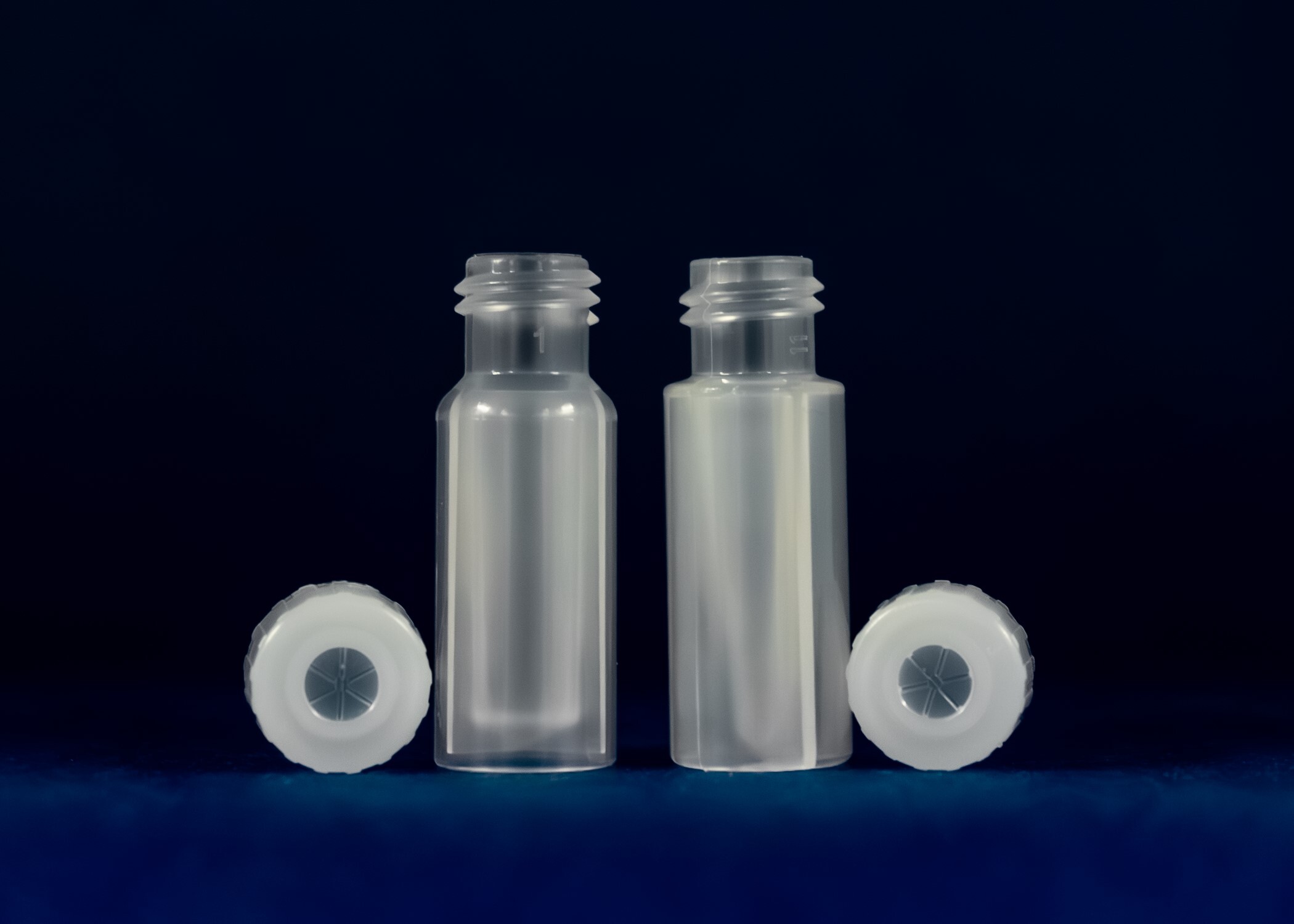
What Vials and Caps are recommended for PFAS analysis
Aug 21st 2025
To minimize the risk of PFAS contamination, it is generally recommended to avoid silicone septa.
For this reason, the preferred configuration is the polypropylene 2 mL screw-thread vial paired with a polyethylene solid cap. These caps are star-scored to ensure reliable autosampler compatibility. Vials are available in 300 µL and 750 µL working volumes:
-
300 µL – PN 2ASRP-KS-U1
-
750 µL – PN 2ASSP-KS-U1
One important note is to avoid polypropylene caps used in combination with polypropylene vials. This recommendation is based on customer feedback from laboratories evaluating alternative suppliers. Their previous issues were resolved after switching to Pursuit Scientific polyethylene caps with polypropylene vials.
Below is a summary of the problems they encountered with competitive polypropylene caps/septa during PFAS analysis:
-
Autosampler needles frequently became lodged in the polypropylene septa during injection, resulting in hardware errors.
-
In some cases, the needle lifted the entire vial after injection. The vial either remained stuck to the needle or was dropped inside the autosampler.
-
Successful injections were only possible after increasing the autosampler temperature from 10 °C to 25 °C. At 10 °C, nearly every injection failed. Increasing the temperature reduced—but did not fully eliminate—the issues.
-
Lot-to-lot variability was significant. One lot performed adequately at 25 °C, while a subsequent lot produced failures in more than half of all injections.