Recommended Vials and Caps for PFAS Analysis | Pursuit Scientific
Aug 21st 2025
What Vials and Caps Should You Use for PFAS Analysis?
Per- and polyfluoroalkyl substances (PFAS) are typically measured at very low concentrations, so even small background contributions from consumables can compromise your data. Vial and cap selection is therefore critical to minimizing contamination and avoiding autosampler failures.
This guide summarizes recommended configurations and real-world issues labs have encountered with competing products.
Recommended vial and cap configuration
To reduce the risk of PFAS contamination and mechanical issues:
-
Avoid silicone septa in PFAS workflows, as they can contribute to background and interfere with low‑level measurements.
-
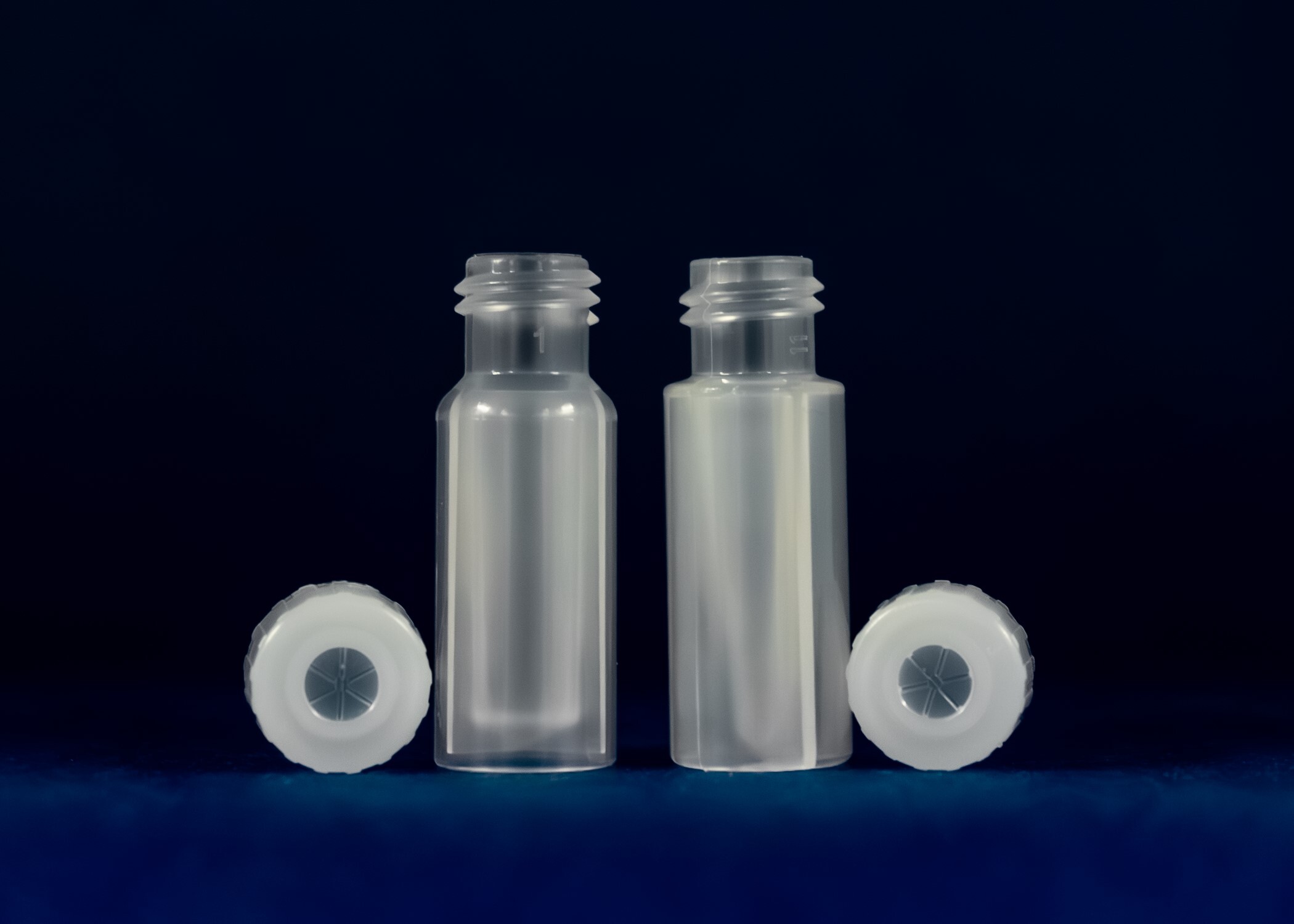
Use a polypropylene 2 mL screw‑thread vial paired with a polyethylene solid cap. This configuration helps minimize PFAS background while maintaining reliable autosampler performance.
Pursuit Scientific recommends the following Polypropylene vial kits for PFAS analysis in 2 mL autosampler formats:
-
300 µL working volume – PN 2ASRP‑KS‑U1
-
750 µL working volume – PN 2ASSP‑KS‑U1
These polyethylene solid caps are star‑scored to promote consistent autosampler needle penetration and secure sealing without introducing PFAS‑related interferences.
Why to avoid polypropylene caps with polypropylene vials
Customer feedback from laboratories evaluating alternative suppliers revealed significant problems when polypropylene caps and septa were used with polypropylene vials for PFAS analysis.
Issues reported included:
-
Autosampler needles frequently becoming lodged in the polypropylene septa during injection, leading to hardware errors and downtime.
-
Needles lifting entire vials after injection; vials either remained stuck on the needle or were dropped inside the autosampler, requiring manual intervention and risking sample mix‑ups.
-
Successful injections only being possible after raising autosampler temperature from 10 °C to 25 °C. At 10 °C, nearly every injection failed; higher temperature reduced but did not eliminate the issue.
-
Significant lot‑to‑lot variability, where one lot performed acceptably at 25 °C while the next lot failed in more than half of injections, undermining method robustness and QC.
These experiences underscore that vial and cap materials, septa design, and manufacturing consistency directly impact PFAS workflows—not just fit and seal.
A more stable choice for PFAS workflows
By switching from competitive polypropylene cap/septa combinations to Pursuit Scientific polyethylene solid caps with polypropylene vials, customers were able to resolve the autosampler problems described above and stabilize their PFAS methods.
For labs running low‑level PFAS methods, the Polypropylene vial kits offer:
-
Reduced PFAS background contribution from consumables.
-
More reliable autosampler operation at typical PFAS sample storage temperatures.
-
Consistent performance across lots to support defensible data and QC.
Next steps
If you’re experiencing unexplained PFAS background, autosampler needle errors, or inconsistent injection performance:
-
Review your current vial/cap configuration, especially any silicone or polypropylene septa in PFAS workflows.
-
Contact Pursuit Scientific for a PFAS‑specific vial and cap recommendation tailored to your autosampler model and method requirements.
For PFAS recommended vial options, see our Polypropylene vial kits designed to minimize PFAS background in 2 mL autosampler formats.